 |
| Credit goes to Bloomberg Business |
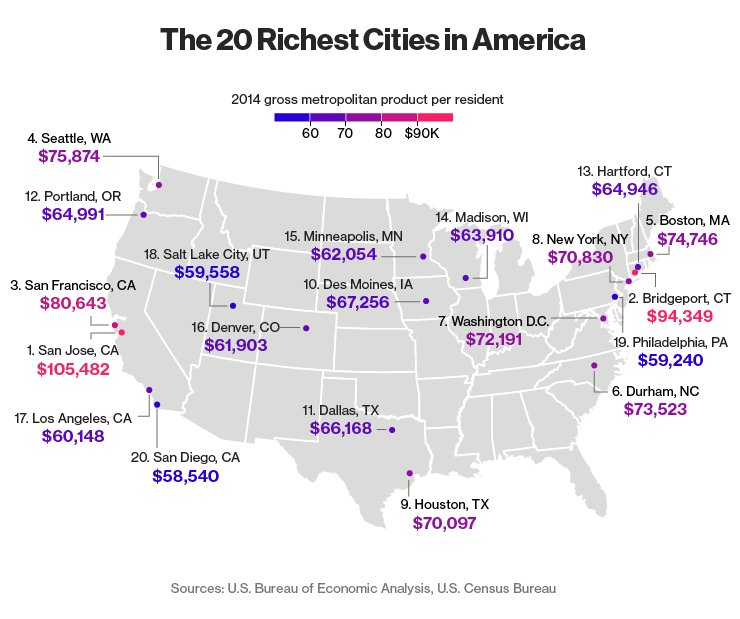
The average income of each resident hovers around 60k, which, when you think about, means that your average Joe walking around Dallas is making pretty okay money. And yet, according to a 2014 article in the Dallas Morning News, the wealth gap between whites and minorities is expanding. But how is this possible? Well what is wealth even? The same article offered this explanation of what is considered "wealth":
"Wealth is defined as the value of an accumulated sum of assets that could include income, financial products like stocks and bonds, retirement accounts or real estate, subtracted from the debt that is owed against those assets. It is built up over time and tends to increase with age. This in part explains the widening racial gap, because blacks tend to earn less than whites and have fewer assets than whites do to pass on to future generations."Other interesting facts? According to the 2010 census, 68 percent of Dallas identifies as white. So the chances that Average Joe up there identifies as white are pretty good. So maybe Dallas is #11 on the wealthiest cities list, but most of that is due to the fact that most of the rich are a white majority that retain most of the "wealth". Consider that the median net worth of white house holds in 2013 was 141,900, versus that of black and Latino households, who's median incomes ranged from about 11,000 to 13,000.
So now that there's some background, I'm going to sort of branch off here a little bit. Within Dallas, there are certain areas that are more affluent than others. For example: you won't find mini-mansions on Cockrell Hill. But you will find them in Highland Park. What's the annual income for a Highlander? About 200k. Yes indeed, the average market price of a home in Highland Park was 1,202,369. Yeah, we're talking big money here. That stereotype that Dallas is rich comes almost exclusively from this little money-bubble. And it's fascinating. It's 94 percent white, 4 percent Hispanic, and .5 percent black. So there is very, very, little diversity here.
I never really cared about this little part of Dallas until a few years ago. My friend got very, very obsessed with the life-style and culture that surrounded Highland Park, and so I sort of got a little intersted too. But I was more interested in the lack of actual diversity that existed here. And what that meant for the teenagers that lived there and went to school at Highland Park Highschool. Highland Park High school is hardly a public school in the stereo-typical sense. These kids are, as stated before, coming from some pretty rich families that are paying some pretty high taxes. The school system better be elite.
So one day last year, I was googling the high school, and I came across some really startling controversies surrounding the high-school. I always figured that HP had some pretty racist and ignorant views just on principle, but I didn't really know that much about it or have any, I don't know, proof. I just had suspicions. But then I started digging. Kind of. I just googled Highland Park controversies.
But according to the Wikipedia page (I know Wikipedia isn't always reliable, but I believe 100 percent that this happened considering that 99 percent of the school is white and they currently have no low-income students attending their school)
In late 2005, The Dallas Morning News published a story about the Friday of Highland Park's homecoming spirit week, on which several seniors dressed as thugs, Mexicans, maids and other caricatures of racial minorities. Some pointed to this as support for the general perception of Highland Park High School and the Park Cities as a "bubble" (as the area is known in the Dallas-Fort Worth Metroplex). The article ignited a storm of letter-writing and editorializing to and in the Morning News. Soon after the article was published, two swastikas were spray-painted on a sign in front of the school.What. The. Freak. What's interesting to me is that I don't think these kids even knew how racist they were being. "On senior Thug Day, students wore Afro wigs, fake gold teeth and baggy jeans. On Fiesta Day, which was to honor Hispanic heritage, one student brought a leaf blower to school." Of course, to us today, this seems completely lacking common sense. But this did happen over a decade ago, and since then, these types of spirit days have been banned. Still, it doesn't mean the mentality has changed at all.
That's the problem with places like Highland Park. It's a bubble, and that's not okay. I get it, being born into a bubble is not the fault of any Highland Park teenager. But that doesn't excuse them from trivializing the various cultures of minorities that live just a few neighborhoods over. Just over the highway. And perhaps these kids don't even realize it, realize how offensive they're being. In all honesty, they don't really have to worry about it because there's not really a reason they would be dealing with minorities and their cultures in the first place. I know that sounds bad, but I just told you that 99 percent of the high school is white.
So places like Highland Park might help drive up the average income and make Dallas look like this rich, over-the-top place to live, but when you've got a wealth gap that is widening, it makes you wonder if places like Highland Park are the real issues at hand.
