Friday, April 8, 2016

Let's talk about a thing called White Privilege.

If you go on any social media platform or online, at all, you'll see a phrase: White Privilege. It sounds relatively simple and straightforward, and yet, it's not. It's a difficult idea to grasp, so I've decided to go undercover and figure out just what white privilege is and what means to have it. Well, not undercover. I mean like I did some research.

The first thing that pops up when 'white privilege' is typed into the search engine of google is this section from the Wikipedia page dedicated to 'white privilege'
White privilege (or white skin privilege) is a term for societal privileges that benefit people identified as white in Western countries, beyond what is commonly experienced by non-white people under the same social, political, or economic circumstances.
What this means to you is basically that by being born white in, specifically, America, sort of gives you an immediate advantage/free pass in life. I'm not trying to be accusatory or say this is true, but give you the basic definition of what it means to have white privilege.

You may ask yourself, do I have 'white privilege'? Well, if you are white, then by definition, you do. In fact, you might not even know that you have such a privilege. And having this privilege isn't anyone's fault. Sure, some may take advantage of it, or take it for granted, but it's nobody's fault that they were born with it. Even though I'm about to sound just like Billy Madison, it's "society's fault."
 My question is, do I have white privilege? I mean, I'm Hispanic, but a lot of people don't think that I am. They guess like three other things before they guess Hispanic. In highschool, I read this book by

 The one thing I hate about this phrase is that is sounds so accusatory. I've always hated how much it makes it seem like white people around the world need to constantly be apologizing for crap that really isn't always their fault. Y

Thursday, February 25, 2016

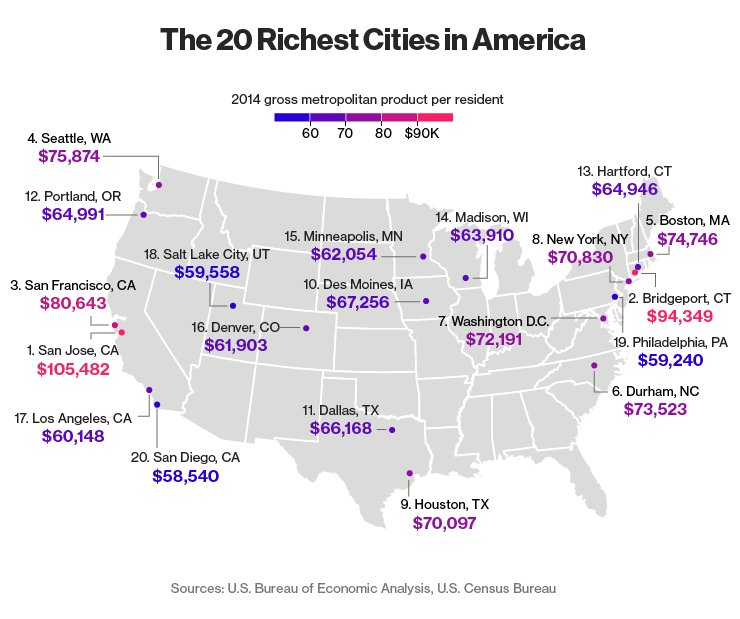
Hey look at this interesting picture.

Credit goes to Bloomberg Business 
I don't know if you can read this very well, but this is a chart of the wealthiest cities in America, or at least, the wealthiest cities in 2014. You'll notice some fan-favorites: San Fran, New York, Boston, Portland. Ah, there it is: Dallas. Number 11. There's a weird part of me that's mad at Houston for being two spots ahead, but I'll place blame on the strange rivalry that exists between Dallas and Houston.
The average income of each resident hovers around 60k, which, when you think about, means that your average Joe walking around Dallas is making pretty okay money. And yet, according to a 2014 article in the Dallas Morning News, the wealth gap between whites and minorities is expanding. But how is this possible? Well what is wealth even? The same article offered this explanation of what is considered "wealth":
"Wealth is defined as the value of an accumulated sum of assets that could include income, financial products like stocks and bonds, retirement accounts or real estate, subtracted from the debt that is owed against those assets. It is built up over time and tends to increase with age. This in part explains the widening racial gap, because blacks tend to earn less than whites and have fewer assets than whites do to pass on to future generations." 
Other interesting facts? According to the 2010 census, 68 percent of Dallas identifies as white. So the chances that Average Joe up there identifies as white are pretty good. So maybe Dallas is #11 on the wealthiest cities list, but most of that is due to the fact that most of the rich are a white majority that retain most of the "wealth". Consider that the median net worth of white house holds in 2013 was 141,900, versus that of black and Latino households, who's median incomes ranged from about 11,000 to 13,000.

So now that there's some background, I'm going to sort of branch off here a little bit. Within Dallas, there are certain areas that are more affluent than others. For example: you won't find mini-mansions on Cockrell Hill. But you will find them in Highland Park. What's the annual income for a Highlander? About 200k. Yes indeed, the average market price of a home in Highland Park was 1,202,369. Yeah, we're talking big money here. That stereotype that Dallas is rich comes almost exclusively from this little money-bubble. And it's fascinating. It's 94 percent white, 4 percent Hispanic, and .5 percent black. So there is very, very, little diversity here.

I never really cared about this little part of Dallas until a few years ago. My friend got very, very obsessed with the life-style and culture that surrounded Highland Park, and so I sort of got a little intersted too. But I was more interested in the lack of actual diversity that existed here. And what that meant for the teenagers that lived there and went to school at Highland Park Highschool. Highland Park High school is hardly a public school in the stereo-typical sense. These kids are, as stated before, coming from some pretty rich families that are paying some pretty high taxes. The school system better be elite.

So one day last year, I was googling the high school, and I came across some really startling controversies surrounding the high-school. I always figured that HP had some pretty racist and ignorant views just on principle, but I didn't really know that much about it or have any, I don't know, proof. I just had suspicions. But then I started digging. Kind of. I just googled Highland Park controversies.

But according to the Wikipedia page (I know Wikipedia isn't always reliable, but I believe 100 percent that this happened considering that 99 percent of the school is white and they currently have no low-income students attending their school)
In late 2005, The Dallas Morning News published a story about the Friday of Highland Park's homecoming spirit week, on which several seniors dressed as thugs, Mexicans, maids and other caricatures of racial minorities. Some pointed to this as support for the general perception of Highland Park High School and the Park Cities as a "bubble" (as the area is known in the Dallas-Fort Worth Metroplex). The article ignited a storm of letter-writing and editorializing to and in the Morning News. Soon after the article was published, two swastikas were spray-painted on a sign in front of the school.
What. The. Freak. What's interesting to me is that I don't think these kids even knew how racist they were being. "On senior Thug Day, students wore Afro wigs, fake gold teeth and baggy jeans. On Fiesta Day, which was to honor Hispanic heritage, one student brought a leaf blower to school." Of course, to us today, this seems completely lacking common sense. But this did happen over a decade ago, and since then, these types of spirit days have been banned. Still, it doesn't mean the mentality has changed at all.

That's the problem with places like Highland Park. It's a bubble, and that's not okay. I get it, being born into a bubble is not the fault of any Highland Park teenager.  But that doesn't excuse them from trivializing the various cultures of minorities that live just a few neighborhoods over. Just over the highway. And perhaps these kids don't even realize it, realize how offensive they're being. In all honesty, they don't really have to worry about it because there's not really a reason they would be dealing with minorities and their cultures in the first place. I know that sounds bad, but I just told you that 99 percent of the high school is white.
So places like Highland Park might help drive up the average income and make Dallas look like this rich, over-the-top place to live, but when you've got a wealth gap that is widening, it makes you wonder if places like Highland Park are the real issues at hand.


Friday, February 12, 2016

Start my day on the Roof

A few weeks ago, I gave you some insight into my life. A quick summary of said post would be that I went to public school and then transferred to private school right before 7th grade, which was a huge change for me. I'm from the suburbs but I spend a great deal of time in the city. And I think I have some insight into some unexplored topics relating to socioeconomic status. Okay....

What I've been sitting here, marinating over, is this one idea about things I've had for a while.

Dallas is such an interesting city to me. I just typed Dallas into Google Search, and I found out that there's gonna be a knew Real Housewives set in Dallas! My mother's fangirls dreams are all coming true! I know I can't wait to watch. Isn't that weird. I don't care at all about these kinds of shows, I think they're uninteresting, and yet here I am, trying to figure out what time and what day the show comes on, and if I can stream it online.

And you want to know why I'm interested? Because I want to see if I know anyone that would be featured on the show. Because it's not out of the realm of possibility. A few years ago this girl in my grade had a few scenes from series Dallas shot in her home. What the "heck"????

So I'm sitting here, wringing my hands, excited to see the parts of Dallas I was highly exposed to exposed to the rest of the world. Because IDK how horses and the phrase "giddy up" (???) got associated with Dallas, but it's not like that ya'll. It might be very Southern and debuntaesque, but there is a certain lifestyle that makes it very Beverly Hillsish (you know, without the prestige of being from California).

I've sort of gone off on a tangent, so let me reel it back in. There is a certain lifestyle that comes from going to a private school. There are certain things a lot of girls can afford to have and a lot of places they can afford to go to. And before I was exposed to that, I didn't even know it was something I would care about, ever.

But the problem with this lifestyle, where you can spend your parents money and not be worried about it in the least, is that it is uncomfortable and not a hundred percent attainable. 

My friends from highschool and I were all suburban kids. Kids who had to take on more independence: wake up for school on time, get yourself there on time, don't miss class and don't get into a wreck. 
That might not sound hard, but some of the girls I went to school with still had their mothers driving them when we were seniors. 

To us, were more worldly than the other sheltered kids. We had the best of both worlds. We could run around Dallas just like most of them, and we could find our way back home afterwards too. 

But like I said, chasing this lifestyle is hard. We are told, shown, made to think that it is the best way, or the way that is the most "beautiful" to live. Ordering 20 dollar meals and taking pictures of it. Going to the mall, but I only have ten bucks. Deciding between gas money and beer money. Getting to a party being held in a guest house and remembering that I don't live ten minutes away like most of these kids do. So do I pay an uber, or do I refrain from partaking in the frivolous merriment of underage drinking?

And then I'm broke. 

We're always talking about money. How to get it, what to do with it. That's different than other groups. I don't think as many other groups have almost gotten into altercations over money as much as we have. Just because it does mean more to us. We were all born to parents, that for some reason or another, decided that living in Dallas, the city itself, would be too much. Usually, those kinds of parents also find themselves raising their children in a more traditional way.

So we chase (who am I kidding, we're still chasing it) this new American dream. It's not the kind of American Dream our parents maybe had, or our grand parents definitely had. It's an American dream that is based on juicing and on vegan brownies. And how aesthetic your Instagram post was (quality over quantity we say as we stew over the fact that it only got 53 likes). We're always posting pictures of ourselves downtown or in Highland Park aka the Moneybubble itself. And it's a way of saying, look at where we are. We're just as good as you are, we can hang out in the same places as you and eat in the same restaurants.

The funny thing is, that by doing this, we're just reestablishing what everyone already knew: that we're just visiting a life that has always belonged to them.

Thursday, January 28, 2016

Honey, I think you were a little hard on the Beaver

I am used to writing about gender and race. I am used to writing about gay rights and the importance of accepting all people at what they are now and not what they were before. I am used to writing about the same topics, my opinions sometimes seem like little lines I've memorized before a big play.  What's funny is that a lot of what I write doesn't even personally affect me. I have passionate views on gay and transgendered rights, but I am neither gay or trans-gendered. I care about media representation and diversity, but most people don't even know that I'm Hispanic, because I don't really look or sound Hispanic. So that kind of struggle doesn't always hit home either.
See, I can write all I want about it, but at the end of the day, sometimes I feel one step removed from it all.
  What I don't write about, a thought that continues to surprise me the more i think about it, is class. You know, socioeconomic status. I guess it always seemed to take a backseat to the more pressing issues, but it does have a large effect on my life and how I got to where I am now.
So this blog post is going to be setting up a great deal of back-story, because I honestly think that class and the difference being middle class can have on you, especially when, for your whole life, you've been around both the extremely poor and the extremely rich.

***
I should start by saying I'm from Dallas. My favorite joke about Dallas is that it is pretentious. Because it is. "Keep Austin Weird? Keep Dallas Pretentious." I've seen that bumper sticker on more than one car. And I'm sitting here like, is that something we should be proud of?

Anyway, so Dallas is this major city. According to the 2010 census, there are about 6 million people living in and around the area. But I think people forget that the suburbs of Dallas are just as important as the city itself. I was born in Arlington, which is smack-dab between Dallas and Dallas' long time frenemy, Fort Worth. I was raised in Grand Prairie, another suburb. You might also know it as the place where Selena Gomez was born and raised.
She is about the coolest thing Grand Prairie has ever produced.
The population there is extremely Hispanic, like Mexican Hispanic. But the funny thing is that since it is technically a suburb, the people of Grand Prairie think that they're somehow above the "ghetto" Hispanics that live in the city itself.
They are not better. I know this first hand. But still, even in a not so spectacular suburb like Grand Prairie, the idea of being better off than someone else is quite alluring.
So I was raised in Grand Prairie. Mostly. I say mostly because, well, it's a little complicated.
See my parents divorced when I was 9 months old, and my mom moved to Irving (another suburb) and my dad moved to Grand Prairie. Than my mom decided to move the two of us out to another suburb called Desoto. And we lived there for a little while. Then my mom got remarried and she moved to Grand Prairie too.
When my parents had me, they were twenty-nine, which is sort of young, but not nearly as young as my grand parents, who were seventeen when they had my dad. My mom was a teacher and my dad was putting himself through college, night school style. So American Dream. They both came from good families, so neither one of them ever considered themselves lower than middle class. But when they got divorced, it was tougher. My mother was making enough to have a good enough life, but she' was a teacher.
My father still hadn't graduated, so his money was good, but not as good as someone with a degree would have. I ask him about that early time in my life, and he always tells me that when he moved us to Grand Prairie, it was always just a temporary situation. We had this tiny yellow house. Wood frame. Built in the late 40s. I heard the trains at night, which was only combated by the sounds of dogs barking. Every once in a while I'd hear the police sirens. Not enough to make me worried or scared. But enough to know that the neighborhood I lived in wasn't exactly screaming Leave It To Beaver.
I honestly didn't care. I had a ton of neighborhood friends and my early adolescence is very reminiscent of a classic 1970s childhood. Little supervision, lots of time. I would say that I was middle class  for a lot of my life.
Like I said before, my mother was a teacher in the city. She taught at a very low-income public school, that I also attended, in a highly Hispanic neighborhood. This neighborhood was made up of immigrants, blue-collar workers, drug-dealers, gang members.
I kid you not, there was a guy named Frankenstein that lived in the neighborhood. He had like 8 different kids with 3 different wives and a fake eyeball that he would pop out and let other kids play with. My mom taught two of his daughters one year, and their respective mothers came to Parent Teacher Conferences, found out their kids were in the same class and got into a physical fight because of it.
That really happened.
So I went to school around all this. My mom used to let me stay over with friends from school, and I guess when I think back on it, she must have been a little worried. It wasn't a good neighborhood. I thought this way of life was normal mostly.
It really wasn't until the seventh grade that my life was very much changed. I wont' go into the whole story, but the gist is that I got accepted into one of the best private schools in the state. It's an all-girls school private school, the kind that people make fun of on television.
Mark Cuban's kids go there. Granted, they're like seven, but yeah, that was the school I got into.
And they paid for me to go. 25,000 dollars every year, for six years.
So no longer am I in a neighborhood where people's houses burn down because they lost control of their meth labs. I'm sitting pretty with girls who have never stepped foot into Walmart. Girls who have nannies and it's not like a joke. I get invited to these pool parties, and every house is larger than the last. I am completely overwhelmed and out of my element. It's a giant culture shock. Before, I was the kid that everyone thought had it all.
And now, I was embarrassed to be from the suburbs. I was embarrassed of my house and the sheer lack of it. I was embarrassed that I didn't know the latest trends or what to wear to football games. I was absolutely lost. I was just some kid who's family was getting by. I didn't have a lot of practice with excess.
Which leads into what I'm going to be focusing on in these next posts.
I'm going to be talking about class. About the various degrees of differences I've been exposed to and how they've affected me and how they have affected people I know. I think going to school in the city really broadened my horizons. I think a lot of situations have really opened my eyes.